
Evidence from Jharkhand, India, shows how implementation intensity can influence learning outcomes (2024–2026)
What does it take to improve foundational literacy at scale?
November 17, 2026

By Kaushlendra Kumar
Director, Research, Monitoring & Evaluation
Room to Read in India
What does it take to improve foundational literacy for more children each year?
Evidence from a large-scale initiative in Jharkhand, India, points to an important factor: how education systems are supported to put effective literacy practices into action. In partnership with the Government of Jharkhand, Room to Read evaluated two approaches to strengthening foundational literacy in government primary schools, examining how different levels of implementation support influenced student learning outcomes over two years. The findings offer important insights into the role of implementation intensity in improving literacy within existing government systems and informing future scale.
The findings at a glance:
Stronger support, greater learning gains
Over two years, Grade 1 and 2 students in government schools receiving Block-level Support saw substantial gains in foundational literacy, including a 30.9 percentage-point increase in literacy scores and a 40.2 percentage-point reduction in non-readers. These results demonstrate that, with the right level of support, learning outcomes can improve significantly within existing government systems at scale.
Inside the project:
Comparing two approaches to systems support
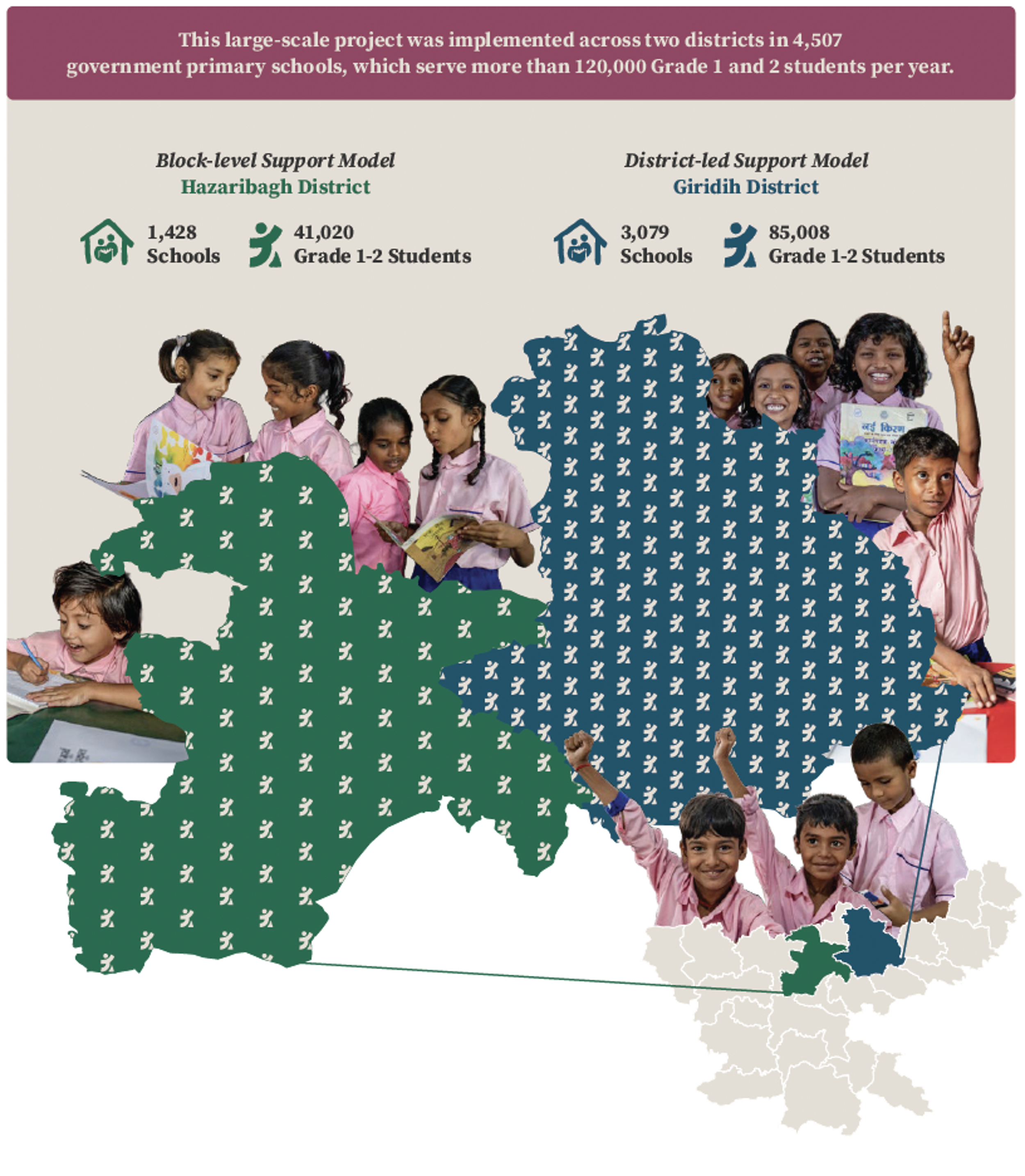
In partnership with the Government of Jharkhand and the districts of Hazaribagh and Giridih, Room to Read implemented a multi-year project to explore how different levels of support for district- and block-level education actors influence student learning outcomes.
Both models included the same core inputs: instructional design, supplementary reading materials, and capacity building for government officials. The difference was in how implementation support was structured.
Block-level Support Model: A dedicated coordinator was assigned to each block.
District-led Support Model: A coordinator was assigned across multiple blocks, relying more heavily on district-wide government structures to cascade implementation.
A third-party evaluation was conducted between 2024 and 2026 through a single-difference longitudinal study examining grade-level gains in literacy among a sample of students over the two years.
What the results reveal: Implementation intensity matters
Improvements in literacy outcomes were observed across both the Block-level and District-led Support Models, with larger gains in the Block-level Support Model.
Key findings include:
Students in Block-level Support Model schools improved literacy composite scores by 30.9 percentage points (1.26 standard deviations) over two years.
Block-level Support Model schools reduced non-readers by 40.2 percentage points and increased proficient readers (defined 35 or more words per minute, the national proficiency benchmark) by 23.3 percentage points.
District-led Support Model schools improved literacy composite scores by 4.5 percentage points (0.22 standard deviations), and reduced non-readers by 5.5 percentage points.
Higher implementation intensity — characterized by closer engagement with block-level education structures to reinforce training, coaching, monitoring and continuous improvement — was associated with substantially stronger learning gains in the evaluated geographies.
Looking ahead:
Three opportunities to strengthen implementation at scale
Learnings from these results suggest that implementation intensity is an important factor; results are also informing further iterations to explore in the future to improve our understanding of how to effectively improve learning outcomes at scale.
These include:
How can implementation intensity evolve as government systems strengthen?
Future approaches could explore whether higher-intensity, block-level support is particularly important during earlier stages of systems strengthening, with district-led support holding greater potential as a transition model once key practices and capacities are adequately embedded within government systems.Can stronger early-stage support accelerate progress within a district-led model?
Further exploration could examine whether increasing coaching frequency during the first year of programming, or providing a greater dosage of fluency activities, can accelerate progress along a district-led pathway.What system-level changes might contribute to longer-term learning improvements?
Either model may have influenced system-level changes that were not immediately visible in student learning outcomes. These could include new policies or improved monitoring systems that were outside the scope of this evaluation but may support learning outcome improvements over the longer term.
From evidence to impact:
Strengthening what works for lasting change
The results from Jharkhand build on a growing pattern of evidence demonstrating Room to Read’s success in driving literacy gains at scale. They reinforce a central Room to Read point of view: improving learning at scale requires more than a strong direct delivery model at the school level. It requires sustained, multi-level implementation approaches, adaptation to context, deep partnership, and disciplined use of evidence to strengthen what works over time.
Room to Read is proud to partner with Prevail Fund on this initiative, with thanks to Outline India for supporting the external evaluation.
Learn more about our unique approach

You might also be interested in...

Addressing linguistic complexity in Indian classrooms
Stuti Jain, Manager of Instructional Design and Structural Support

What does it take to improve foundational literacy at scale?
Kaushlendra Kumar, Director, Research, Monitoring & Evaluation, Room to Read in India

Foundational skills and future readiness: The workforce of 2040 is sitting in today's classrooms
Poornima Garg, Country Director, Room to Read in India