Building an evaluation tool to see inside the classroom
March 23, 2026



By Rebecca Westbrook, Pinaki Joddar and Japheth Ogol
Room to Read Global Research, Monitoring & Evaluation
In a Grade 2 classroom in Nepal, a teacher moves through a language lesson with confidence. She uses Room to Read’s teacher guide, encourages children to read aloud and keeps children engaged from the first minute to the last. Across the border in Jharkhand, India, a Grade 1 teacher manages a multigrade classroom, splitting her attention between two or more groups of children, navigating a phonics lesson for each within an already tight lesson schedule.
Both classrooms are part of Room to Read's Literacy Program. Both teachers have received training and on-site coaching. But what is actually happening during those lessons? And how do we measure it with the rigor needed to explore what teacher practices are most important for improving children’s learning outcomes?
Building from the existing knowledge base
Room to Read has long used a classroom observation tool as part of our coaching and mentoring support for teachers. Coaches visit classrooms, observe lessons and provide structured feedback to help teachers improve their practice. Our classroom observation tool was designed for program monitoring — focused on measuring coach and teacher fidelity to key aspects of the program’s design as well as providing a structured mechanism for feedback to teachers.
In 2024, we began developing a new classroom observation tool specifically designed for evaluation. The team started with a comprehensive review of established instruments — including the World Bank's TEACH tool, the Stallings Classroom Observation tool and RTI's Learning at Scale tool — before building on these frameworks and drawing from the experience of our program monitoring classroom observation tool to create something tailored to our early grade literacy instruction programming.
The new tool is structured in four interconnected sections:
- Lesson structure and context — lesson duration, start-time adherence, and material availability
- Time on task — a key new addition for Room to Read: timed snapshots that occur every five minutes, recording both teacher and student actions, and which literacy skills are being taught
- Teacher practices rating scale — 15 items across classroom interaction, instructional practices, and formative assessment, rated on binary or three-point scales
- Qualitative summary — five open-ended prompts to capture what numbers alone may miss
The timed snapshot method is the most significant departure from our program monitoring classroom tool. Rather than relying on an observer's impression of how time was used, it produces a precise, quantified picture of teacher and student actions across the full lesson.
What four countries revealed
Since 2024, the tool has been used across four countries — India, Bangladesh, Nepal and South Africa — with more than 150 teachers observed at different stages of program implementation.
The time-on-task data has provided us with a deeper understanding of what is happening inside the classroom. In Nepal, teachers used 100 percent of the available lesson time for active teaching1 and children were engaged in every observed lesson. In India, scheduled lesson time was well below government policy, and multigrade classrooms created significant complexity in how time was distributed and used.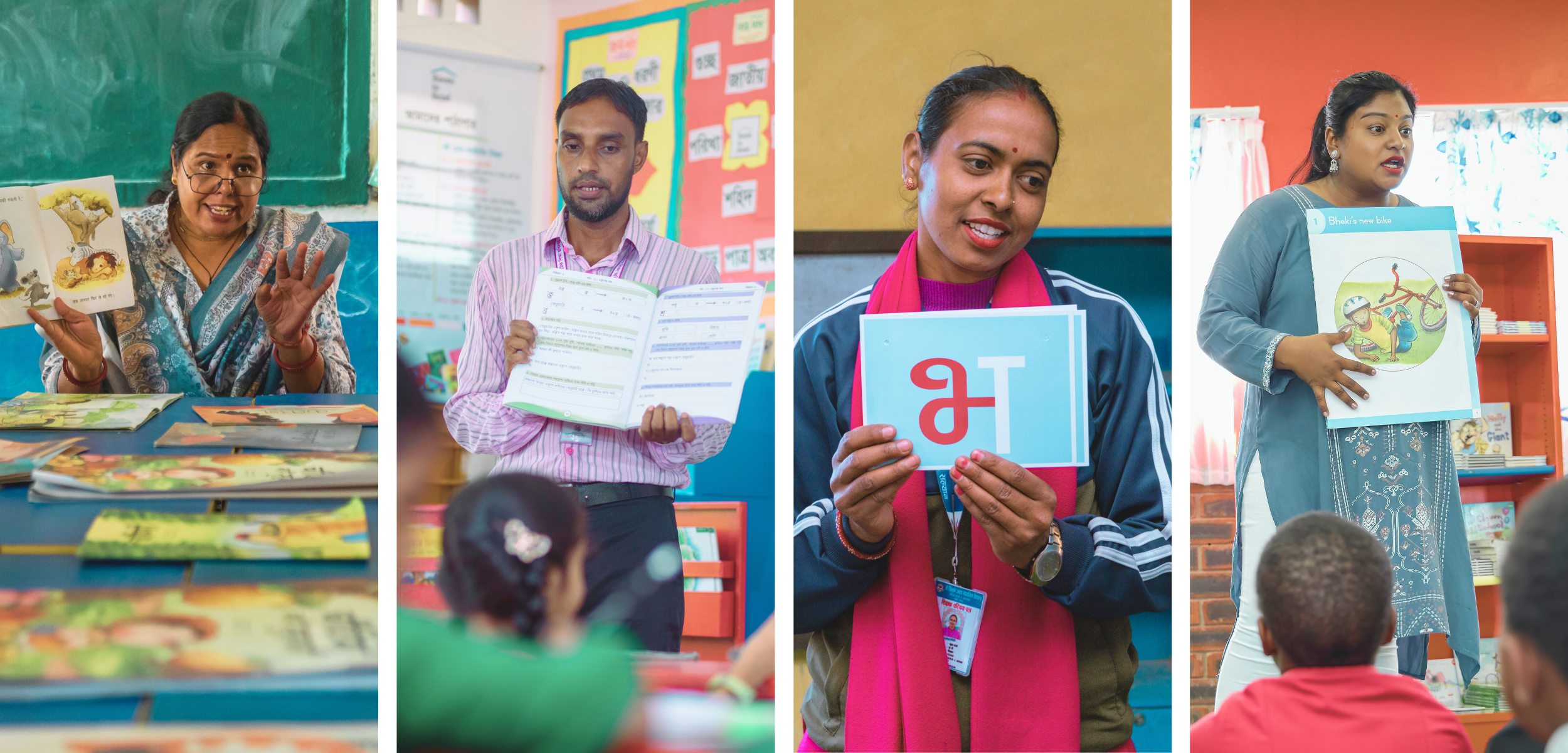
Across all four contexts, one finding stood out consistently: Phonological awareness received very little instructional time — a pattern that has direct implications for teacher training priorities.
The data also revealed that whole-group instruction dominated across all contexts, ranging from 38 percent to 97 percent of lesson time, while small-group and peer work accounted for just 1–2 percent of observed time everywhere. Individual coaching visit data would have struggled to discover this system-level pattern, highlighting the advantage of including timed snapshots in the evaluative tool.
What high-inference data can and cannot tell us
One of the most important methodological insights to emerge from this work is the difference between low-inference and high-inference data. The timed snapshot sections — which precisely quantify how teachers use time — have produced consistent and reliable results across observers. The teacher practices rating scale, which asks observers to make qualitative judgments about instructional quality, has been harder for observers to mark reliably without deep technical knowledge of early grade literacy instruction.
Observation scores and snapshot data have sometimes pointed in different directions — and that tension is itself a finding, shaping our next iteration of the tool. 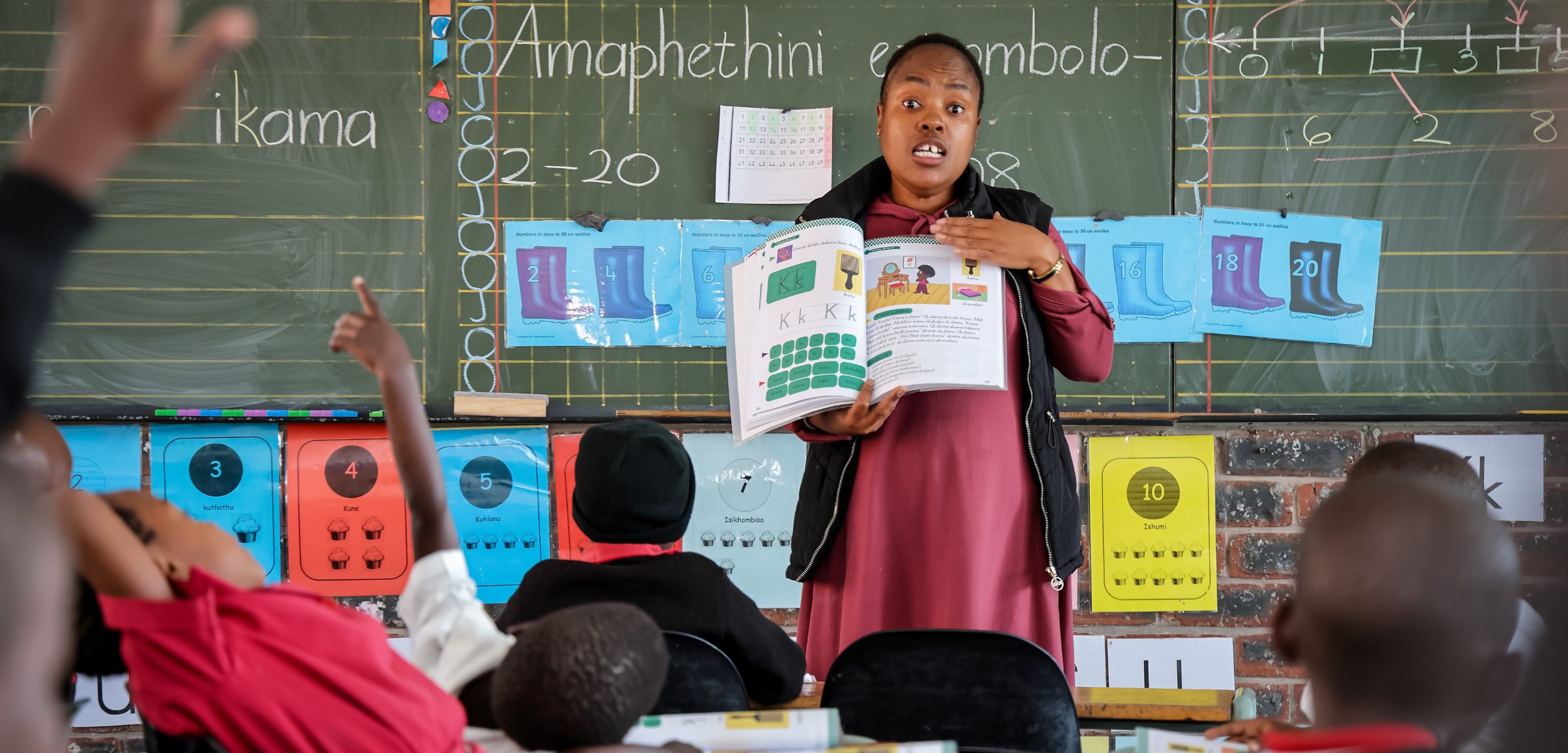
What comes next
Each use has directly informed the tool's ongoing refinement. The team is now exploring repeated observations across the school year to better capture variation in teacher practices over time, piloting the tool with Room to Read local country staff who are testing whether technical expertise improves validity, and transitioning from paper to electronic data collection for language periods implemented in one continuous session.
Most importantly, establishing predictive validity — linking classroom observation indicators to children's learning outcomes — is our top priority. Our program monitoring classroom observation tool was designed to support improvements to teacher practices. This new evaluative tool is designed to help us understand, at scale, which practices matter most for children's literacy.
Both are necessary. Together, they give us a fuller picture of what great teaching looks like — and how to support more of it.
Our expertise in teacher training & coaching
You might also be interested in...

Measuring impact: The journey of Room to Read data
Kayla Nachtsheim, Manager of Data and Learning