

Girls education around the world and the role of life skills
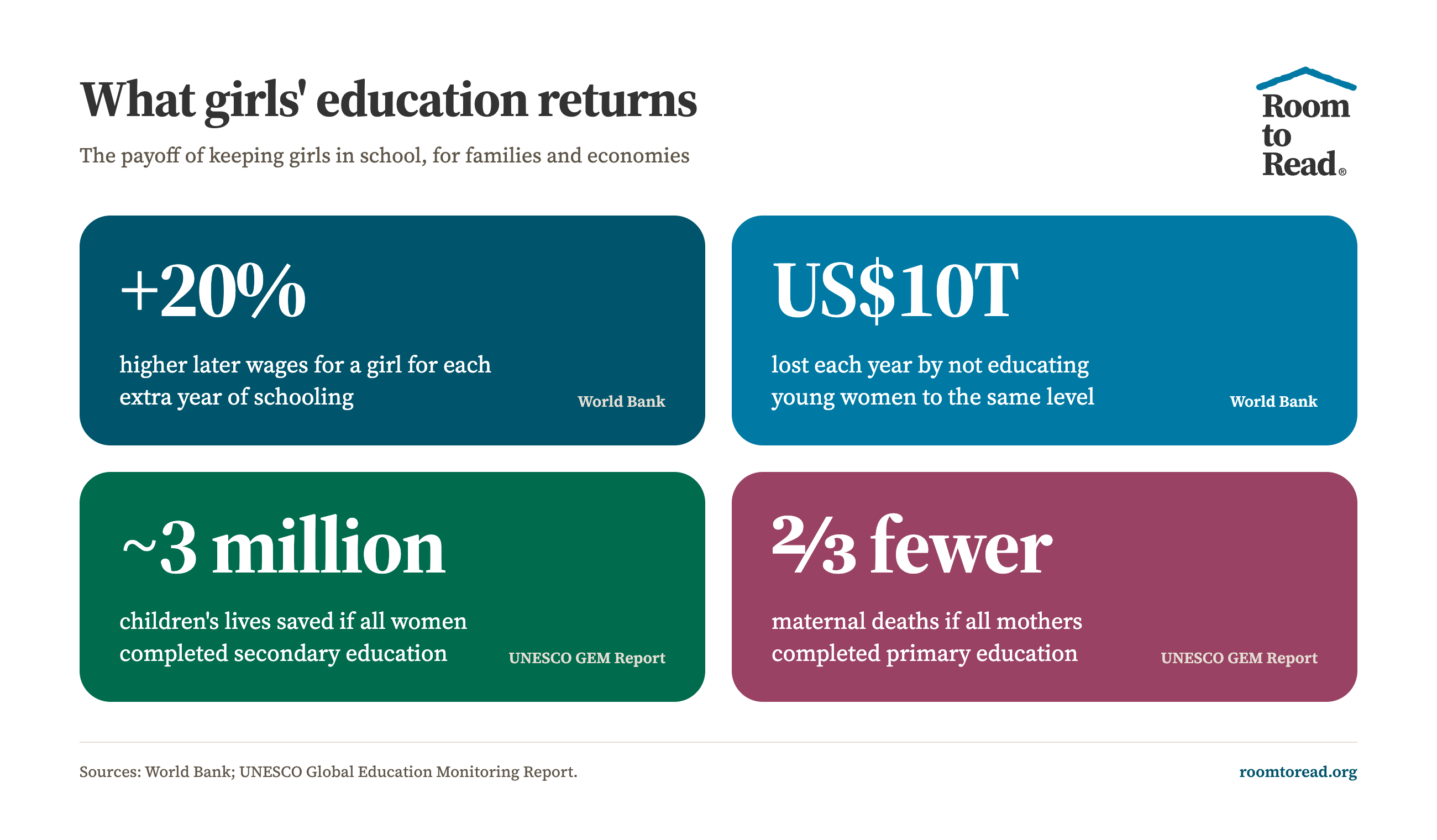
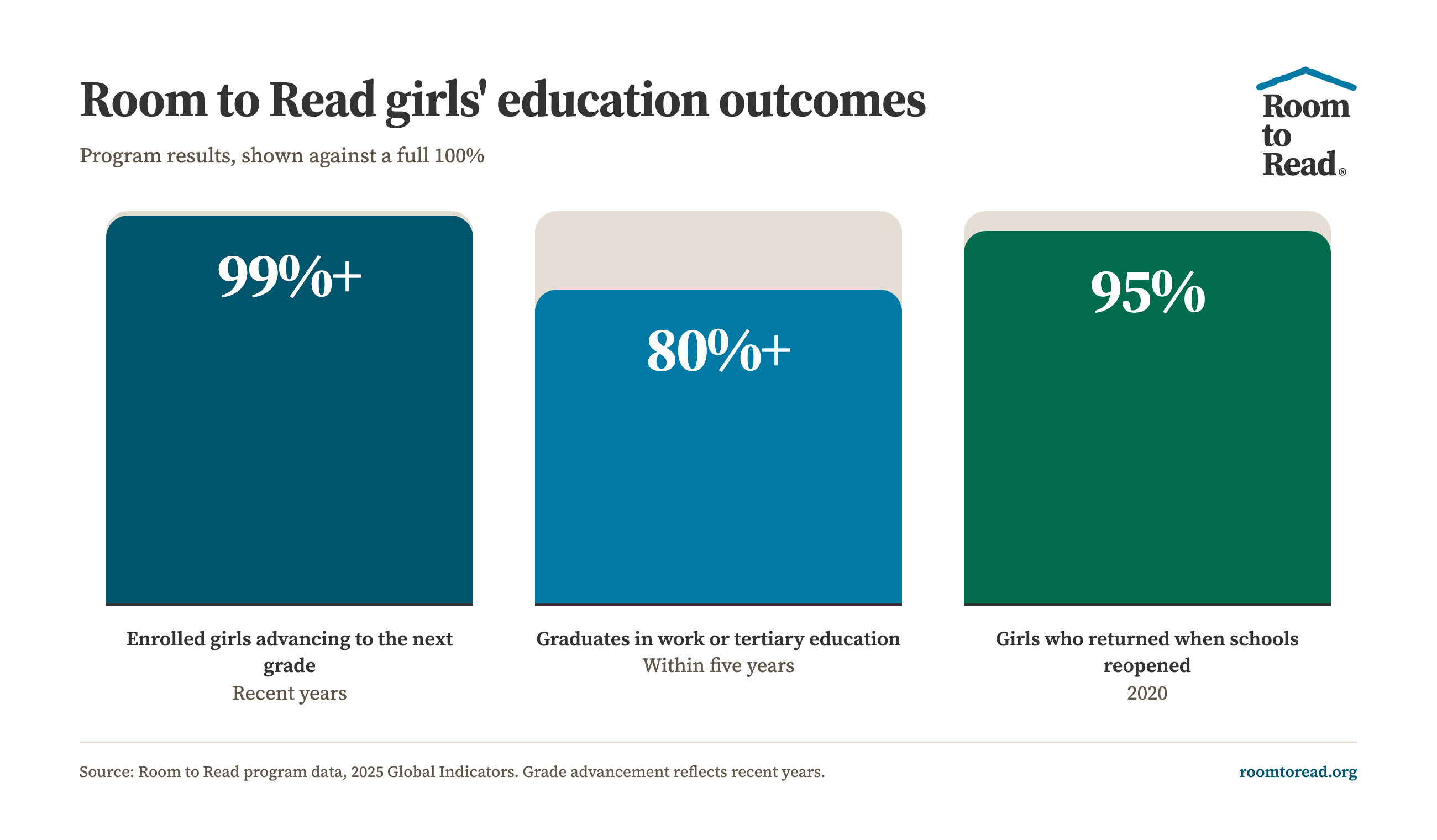
Girls' education is closer to parity than it has ever been, and the gap that remains is concentrated in adolescence, at the point where primary school gives way to secondary school. According to UNESCO, 122 million girls are out of school worldwide, and most of the girls who leave do so at that transition, when the costs of schooling and the expectations of their families weigh most heavily on whether they continue. Room to Read is a nonprofit organization that has worked on children's literacy and girls' schooling since 2000, on the belief that World Change Starts with Educated Children®, and has benefited more than 60 million children across 29 geographies. Our Girls' Education Program works with girls through those adolescent years, and our program data and the wider research point to the same conclusion, that girls who build life skills with steady support from mentors and their families are equipped to make decisions about their own education, with grade advancement and completion following as results. The sections that follow set out the global picture and why it produces such large returns, then trace when and why girls leave school and how life skills and support help them continue, before closing with who we are and how our program responds. Measured stage by stage, progress shows the pattern described above, with the largest remaining gaps in adolescence and in adulthood. Girls now enter primary school in numbers close to boys across most regions, so the count of girls who never begin school has fallen sharply, while gaps persist in secondary completion and in literacy among adults, which reflects the schooling of a generation ago. Progress toward the global education goals set for 2030 is uneven as well. According to the Global Education Monitoring Report, only one in six countries is on track to meet those goals, which leaves most countries short of their commitments on the current trajectory. The girls behind the global out-of-school figure cited at the start of this article are concentrated in historically under-resourced communities. Within those countries they are most often girls from rural communities, girls who are the first in their families to reach secondary school and girls whose schooling competes with work at home. That concentration shows where support is most likely to pay off, because a shortfall that gathers at the transition to secondary school in particular regions is one that a focused program can address. The adult literacy ratios in the table measure the schooling of the past, so they record exclusion that happened 20 and 30 years ago. Because the girls who stayed in school over those decades have become literate women, the adult gap is closing, and the enrollment gap for today's girls is already far smaller than the literacy gap among today's adults. The gains in schooling among today's girls will therefore show up in adult literacy figures over the decades ahead. Closing the gaps in secondary completion and adult literacy matters because this progress carries returns that extend well beyond the girl herself, into her earnings, her health and the schooling of her children. Economists treat it as one of the highest-return investments available, and the evidence for those returns is consistent across the institutions that measure them. Among those returns, wages show the economic effect most directly. According to the World Bank, an extra year of schooling raises a girl's later earnings by about 20 percent, a return that compounds across a working life and across the households those earnings support. Across whole economies, the World Bank estimates that failing to educate young women to the same level as young men costs US$10 trillion a year in lost earnings and productivity. That total is built from individual differences in earnings, between a young woman who finishes secondary school and enters paid work with stronger bargaining power and one who leaves school before completing it. The health returns are just as well established as the wage returns and arrive within a single generation. According to the Global Education Monitoring Report, if all women completed secondary education, child deaths would fall by roughly half, saving about three million lives, and if all mothers completed primary education, maternal deaths would fall by two-thirds. Because a girl who stays in school longer tends to marry later, have fewer and healthier children and see her own children through school, the benefits of her education carry forward into the next generation. For the same reason, it appears in health and economic strategies well beyond the education sector, and connects to the wider question of what girls' education makes possible. Because the returns described above depend on girls completing secondary school, the point at which girls leave school matters as much as the number who leave. Girls most often leave at the transition from primary to secondary school, and the causes are practical barriers and family expectations that gather in adolescence, in a pattern consistent enough from one region to another that a program designed in one country can work in another. The completion ratios in the table above trace when girls leave, with the gap small in the early years of school and widening through secondary school until about two girls complete upper secondary for every three boys in historically low-income countries. UNICEF finds the same pattern across countries, with 49 percent of countries having achieved gender parity in primary education and only 24 percent at upper-secondary level, which places the greatest risk to a girl's education in her adolescent years. The same transition point recurs in very different settings, including Nepal and Tanzania, where Room to Read's program works, and it appears in the country analyses of girls' education in India and girls' education in Africa. A girl who reaches secondary school has already cleared the barriers that stop the youngest children, and in adolescence she meets a different set. The barriers that meet girls at the secondary transition are concrete, which makes them possible to address. Among them, the most common are the cost of fees, uniforms and travel, long or unsafe walks to a secondary school farther from home, the domestic work expected of a daughter as she grows older and the risk of forced marriage. Family expectations run through all of these barriers, because a family weighing what secondary school costs against what a daughter contributes at home is in effect deciding whether her education should continue. Each barrier is a condition in a girl's surroundings, and naming it precisely is what makes a fitting response possible. A girl whose nearest secondary school is two hours' walk away needs a different response from a girl at risk of forced marriage at 15, so a program has to identify which conditions apply to each girl and her family before it can respond. Because the barriers to secondary schooling gather in adolescence and pass through decisions made at home, our program works with girls through the same secondary years and starts with life skills. Life skills equip a girl to weigh choices about her own education, and mentorship and family engagement help make those choices possible, with grade advancement and completion following as results. The life skills at the center of the program are collaboration, resilience, leadership, decision-making and critical thinking, the five domains taught through our life skills curriculum. A girl who can make decisions, work with others and think critically is better placed to respond to the pressures described above, including a family's weighing of costs and the risk of forced marriage, and to take part in decisions about whether she continues at school. The same skills help adolescents recognize their own worth and build the confidence to keep learning as their circumstances change, which prepares them for adult life and work beyond the classroom. Alongside the life skills curriculum, each girl is supported by a mentor, a trained woman from her own community who meets with her regularly and works with her family. The mentor's place in the community makes her credible to a family deciding whether a daughter should continue at school, and because she sees each girl regularly, she can step in early when a short absence risks becoming a permanent one. Because family expectations run through the barriers described earlier, the program also engages parents and community members directly. When a trusted mentor from their own community supports a daughter's schooling, families become more willing to let her continue, particularly in the years when pressure to withdraw a daughter from school runs highest. The relationships built with families also held when schools closed in 2020, and 95 percent of girls in our program returned to the classroom once their schools reopened. Over 99 percent of girls enrolled in the program advance to the next grade. Within five years of graduation, more than 80 percent of the program's graduates secure work or enroll in tertiary education. Participant feedback is consistent with those outcomes, although it is weaker evidence than grade advancement or employment. In a study of 34,000 girls in our program in Rajasthan and Chhattisgarh, India, 100 percent of the girls interviewed described the life skills education as beneficial. The program described above is one part of Room to Read's wider work on children's literacy and gender equality in education, and its results depend on the scale, local leadership and partnerships behind it. Our gender equality programming has benefited more than 4.5 million adolescents across 14 geographies, from Nepal and India to Tanzania and Zambia. Our reach across those geographies rests on local leadership. Nearly 90 percent of our employees are based in the countries where we work, and local nationals lead our community-based operations from program design to implementation, so programs are designed and run by people from the communities they serve. Local leadership is one reason our work has earned 18 four-star ratings from Charity Navigator and a place in HundrED's Hall of Fame, where we were chosen from 3,500 organizations by a jury of 194 experts. By the end of 2025 we had invested more than US$1 billion in foundational learning, and in 2025 alone our programs actively benefited 17 million children. Our program responds to the barriers set out earlier in this article by pairing the life skills curriculum with mentorship from women in the community, sustained engagement with families and schools and material support where fees or supplies stand in the way. The program works with girls across the whole secondary transition, the stage where the completion gaps described earlier open. Each of those program components corresponds to a barrier that pushes girls out of school in adolescence. Material support addresses the cost of fees and supplies where those costs stand in the way, and mentors and family engagement address the household expectations and the risk of forced marriage that weigh on a daughter's schooling. The life skills curriculum then equips each girl to take part in those decisions herself, which is why we lead with life skills and treat grade advancement as the result. The program components described above work within individual communities, and extending them to more girls depends on our work alongside governments and local partners. Supporting this work through Room to Read therefore invests in more than one program, funding the systems, partnerships and infrastructure that let an approach proven in one district benefit girls at scale. The practical options for contributing to that work are set out in how to support girls' education. The evidence set out in this article grows each year, as our program data and new research on life skills and the transition to secondary school are published. Our email subscribers receive those program results and new research first, so the signup form below is the most direct way to follow how girls in our programs progress through school and into work. Sign up below to receive Room to Read program results and new research as they are published.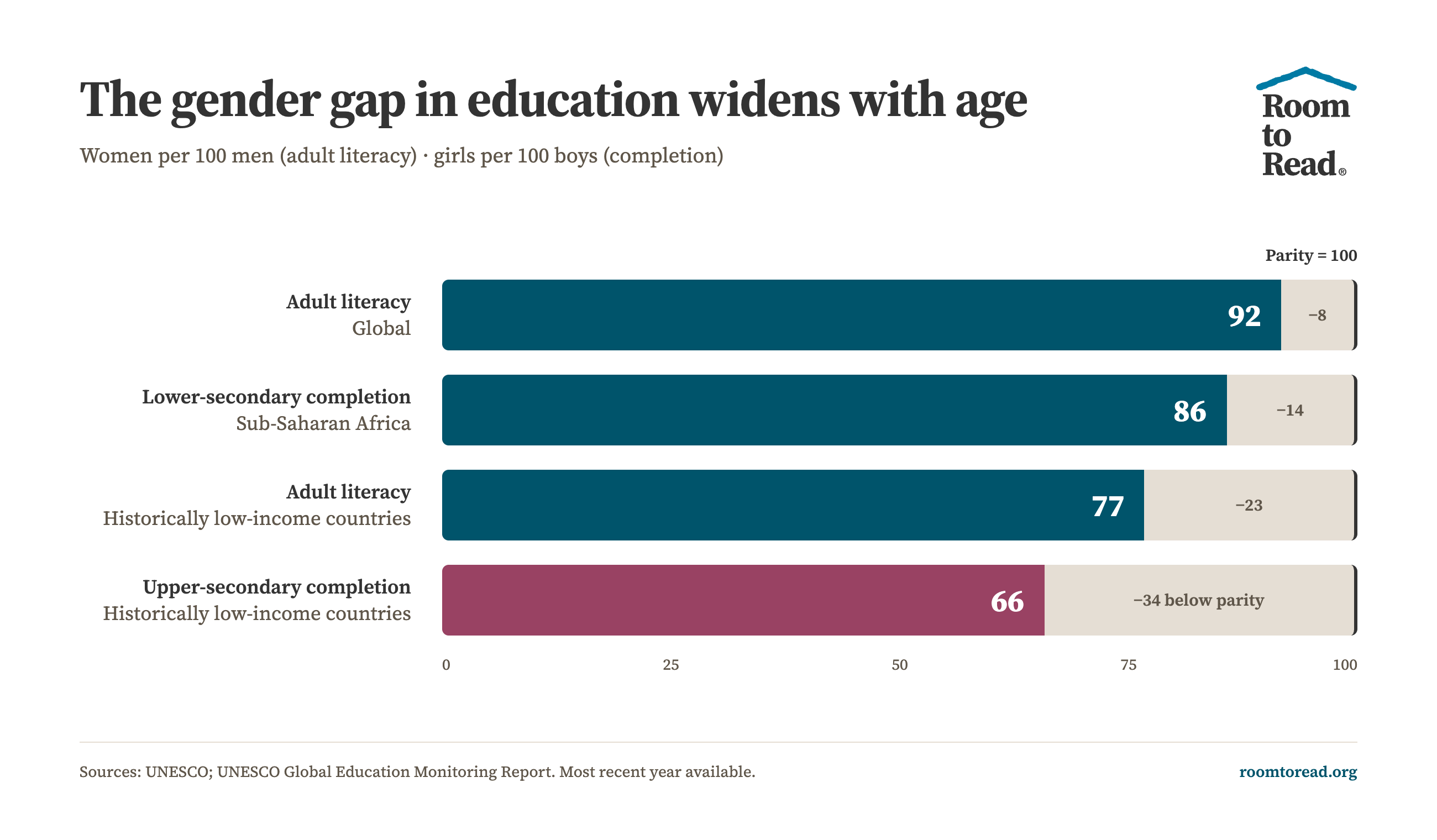
Where the girls who are out of school are concentrated
Why the adult literacy gap reflects past schooling
Why do the returns matter so much?
The economic returns

The health and next-generation returns
When and why do girls leave school?
The transition to secondary school

The barriers girls face in adolescence

How life skills help girls make decisions about their education
Five life skills domains

Mentorship from women in the community

Working with families
What our program data show
What Room to Read is

Local leadership
Independent recognition and investment
How Room to Read addresses these barriers

How the program answers each barrier
Investing in systems and partnerships
How to stay informed