

What the data show about girls' education in India
Literacy among women and girls in India stood at 81 percent in 2023-24, according to India's National Sample Survey Office, seven percentage points below the rate for men and boys. Room to Read is a nonprofit organization that has supported foundational learning skills, including literacy in the early grades and life skills in secondary school, since 2000, with long-running work in India, and has benefited more than 60 million children across 29 geographies. Behind that national figure, the steepest losses come as children move into secondary school. According to UNICEF, around half of adolescents in India do not complete secondary education, and the barriers that lead girls to leave gather in those same adolescent years. This article looks at where girls' education in India stands today, why girls leave school as they reach adolescence and what our program data show about the life skills and support that help girls continue their education. India is one country's part of the wider picture of girls' education around the world. The national survey data show two divides in literacy — the foundation for all future learning. One divide between women and girls and men and boys and another by place, with literacy in rural areas 13 percentage points below urban areas. Literacy rate, age 7 and above (India, 2023-24) Rate Women and girls 81 percent Men and boys 88 percent People in urban areas 90 percent Source: India National Sample Survey Office, 2023-24. Girls from rural communities meet both divides at once, and so do girls who are the first in their families to reach secondary school. India's progress is part of a wider global effort on girls' education, in which, according to UNESCO, 122 million girls remain out of school worldwide. The UNICEF completion figures point to the move from elementary to secondary school as the point where many girls' education ends. Practical and social conditions around a girl lie behind that transition, and naming them precisely is what makes a response possible. Secondary schools are often farther from home than primary schools, and the years when girls attend them are also the years when families' expectations of a daughter begin to shift toward work at home or marriage. What a girl gains from staying is substantial, since according to the World Bank each additional year of schooling raises a girl's later earnings by up to 20 percent. Among the barriers girls in these years face are the cost of fees, uniforms, books and travel, long or unsafe routes to a distant secondary school, the household work expected of a daughter as she grows older and the risk of forced marriage. Each is a condition in a girl's surroundings, which means the people and systems around her can change it. Family expectations run through every one of these barriers, because a family weighing what secondary school costs against what a daughter contributes at home is in effect deciding whether her education should continue. Support that reaches a girl's family as well as the girl herself therefore addresses more of what shapes that decision. Because these barriers are both practical and social, the support that helps girls continue works at both levels. At Room to Read, our Girls' Education Program pairs a life skills curriculum with mentorship from a trained woman in each girl's community, engages families directly and provides material support where fees or the cost of safe transport stand in the way. The life skills curriculum covers collaboration, resilience, leadership, decision-making and critical thinking. These skills help adolescents recognize their own worth and develop the confidence to keep learning and to manage change in their lives, which matters most in the years when choices about school are being made. A girl who can weigh her options and speak up within her own family is better placed to continue her education when pressure to leave arises. Grade advancement and completion follow from that foundation. Each mentor meets regularly with the girls she supports and watches for early signs that a girl may leave school, including repeated absences, falling exam results and parents missing school meetings. When those signs appear, she meets the girl's family to understand what has changed and to work out how the girl can keep attending. Because the mentor comes from the same community, families already know her, which makes a conversation about a daughter's schooling easier to begin and more likely to be heard. Across the geographies where our Girls' Education Program operates, including India, over 99 percent of enrolled girls have advanced to the next grade in recent years. More than 80 percent of the program's graduates secure work or enroll in tertiary education within five years of graduation. When schools closed in 2020, 95 percent of girls in our program returned to the classroom once their schools reopened. The program described above is one part of a global organization. Room to Read has supported foundational learning skills, including literacy in the early grades and life skills in secondary school, since 2000, on the belief that World Change Starts with Educated Children®, and in 2025 our programs actively benefited 17 million children. Nearly 90 percent of our more than 1,200 staff are based in the countries where we work, so programs are designed and run by people from the communities they serve. Our work has earned 20 four-star ratings from Charity Navigator and a place in HundrED's Hall of Fame. Our gender equality programming has benefited more than 4.5 million adolescents across 14 geographies. India is one of the geographies where both our Girls' Education Program and our literacy work operate, led by community-based teams who work alongside families and state governments. In India, our work addresses girls' education at two stages, supporting adolescent girls through the Girls' Education Program and strengthening the reading skills that every child carries into secondary school. Mentors meet the same group of girls in regular life skills sessions throughout the school year, so decision-making and the other life skills become habits and each girl has an adult who notices early when she stops attending. The program's material support means that a family's decision about a daughter's schooling does not turn on a single expense such as a school fee or a bus fare. Secondary school builds on the reading skills children form in the primary grades, so we also work alongside state governments in India to strengthen foundational literacy in public primary schools. With the Government of Rajasthan, we have scaled an evidence-based literacy approach to about 2,600 primary schools in Jodhpur, where children gained a 16-word-per-minute advantage in reading fluency over comparison schools and were three to four times more likely to meet reading benchmarks. Support for our work in India therefore also funds the state partnerships that carry this literacy approach to thousands of public schools, alongside the direct support that girls receive through the Girls' Education Program. Donors interested in the broader picture can see how to support girls' education across all the geographies where we work. Girls' education in India continues to change as more girls move through secondary school, and our program results show where support makes the greatest difference. Our email subscribers receive new program results and research on girls' education first. Sign up below to receive Room to Read program results and new research on girls' education in India as they are published.Where are the literacy gaps widest?
Why do girls in India leave school during adolescence?

Why the secondary years matter
The barriers girls face in adolescence
What helps girls in India continue their education?

Life skills as the foundation
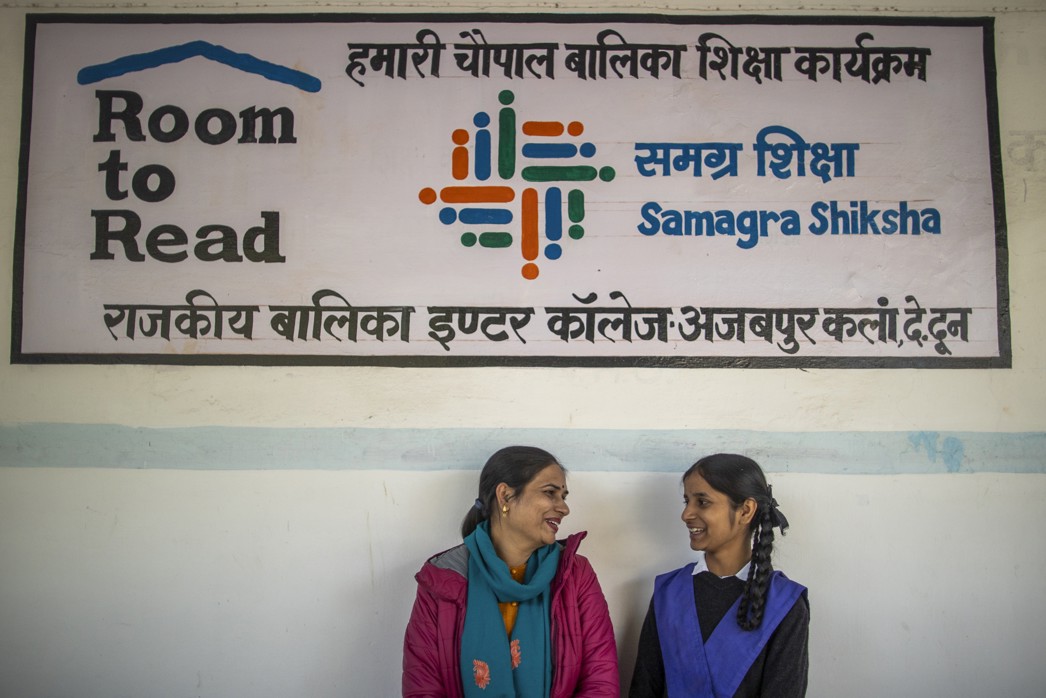
Mentors and families
What the results show
What Room to Read is

A global organization with local leadership
Our work in India
How Room to Read addresses girls' education in India
The program through the school year
Working alongside government at scale
How to stay informed