
Our first country of operation, Room to Read Nepal, pioneered much of Room to Read’s early work. Today, our literacy and girls’ education programs thrive throughout Nepal and we continue to be a catalyst for change in the country’s educational landscape.

Nepal
For many years, public access to education was nearly non-existent in Nepal, and the country’s literacy rate was extremely low, estimated to be 2 to 5 percent of the total population. This was largely a result of the authoritarian rule of the Rana regime, which ruled Nepal for just over a century, as it was wary of educating the masses, fearing it would lead to social and political uprising. Following the overthrow of the Rana regime in 1951, Nepal’s education landscape underwent a dramatic shift, adopting a new identity that was inclusive of all Nepalese people, rather than being reserved solely for elites. Today, while Nepal has achieved positive strides in overall school enrolment rates, there remain deep inequities in education quality and student outcomes. Disparities persist in educational attainment as a result of children’s different economic, geographical and ethnic backgrounds — by the age of 19, only one in five children from the poorest 20 percent of households in Nepal will still be in school, as opposed to four out of five of those from the wealthiest 20 percent of households. Further, enrollment in secondary school in rural areas is nearly 15 percentage points lower than in urban areas; in the rural Mekong Delta and Central Highlands specifically, children’s learning outcomes have been significantly falling behind those of their peers living in other areas in the last decade. Historical context
The 1950s were then marked as an era of democratization and a gradual expansion of educational opportunities. The following decades saw the establishment of more schools and colleges across the country, with a growing emphasis on making education accessible to a wider population. National education plans and governing groups were introduced — such as the National Education Planning Commission, the National Education Advisory Board and the New Education System Plan — aiming to systemize, standardize and expand the education sector. More recent decades of education reform have been guided by Nepal’s School Sector Reform Plan. While progress has been made in terms of enrollment and literacy rates, disparities based on gender, caste, and geographical location continue to be significant. 
Current learning challenges
As a result, literacy remains below the global average, with an estimated 70 percent of people in Nepal over the age of 15 able to read a simple text, according to the World Bank. There also remain notable disparities in literacy rates between men and women in Nepal, reflecting a nearly 15 percentage point gap that leaves women often trailing behind men. Nepal also has an alarmingly high prevalence of child marriage, with one of the highest rates in Asia, for both girls and boys. More than 30 percent of young women aged 20–24 report that they were married by the age of 18, and just 10 percent by 15. Boys are among the most likely in the world to be child grooms, with over 10 percent married before they turn 18.
Nepal is also among the countries most at-risk of experiencing climate-related disasters, posing significant dangers to children’s ability to attend school — disproportionately affecting girls’ learning potential, with an estimated 12.5 million girls prevented from completing their education due to climate-related events every year.
The Latest from Nepal
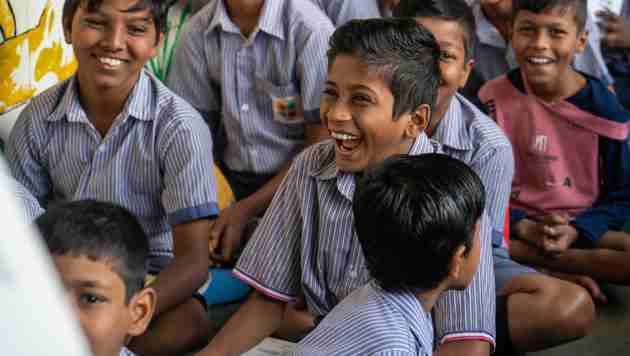
Measuring life skills among boys in India and Nepal
Dhiraj Anand, Associate Director, Research, Monitoring and Evaluation, Gender Equality Portfolio

Life skills classes: Making room for empathy and understanding
Reema Shrestha, Director of Room to Read's Gender Equality Portfolio, South Asia

The healing power of books: Riyan finds refuge in reading
Nistha Shrestha, Senior Officer, Communications, Room to Read in Nepal

Chandani’s chapter, 18 years on: Proof that girls’ education works

Climate change and gender equality: Why girls’ education is key to climate resilience
Reema Shrestha, Director, Room to Read's Gender Equality Portfolio, South Asia

"If I love sports, I shall pursue them with all my heart and soul."
