
Cambodia is rebuilding its educational system from the ground up after years of upheaval. To aid in this effort, Room to Read Cambodia has led in the field of literacy and girls’ education and works as one of the national government’s primary partners improving Cambodia’s quality of education.

Cambodia
Over the last fifty years, Cambodia’s history has been marked by significant turmoil and tragedy, the effects of which have reverberated through generations of families and communities. The most devastating period, the Khmer Rouge regime in the mid to late 1970s, tore apart the country’s education system through genocidal violence and radical policies. Schools were closed, teachers and intellectuals were targeted for execution, and an entire generation was deprived of formal learning amid unfathomable atrocities. Today, 90 percent of 10-year-olds in the country are unable to read simple text, according to the World Bank, resulting in persistently high illiteracy rates. Especially for children in rural, lower-income households, this learning gap limits their future earning potential and career opportunities, perpetuating generational cycles of poverty and poor health. Historical context
After the fall of the Khmer Rouge regime, the country began a long and difficult period of reconstruction. Instability and conflict persisted throughout the 1980s, further hampering progress. It wasn’t until the 1990s that Cambodia began to experience a measure of stability, allowing for more focused efforts on rebuilding and healing.
The lingering effects of this tumultuous period are still felt today, especially in Cambodia’s educational landscape. The tragic loss of a generation of educators, alongside the psychological trauma and ongoing economic hardships and climate-related disasters, has made it challenging for Cambodia to catch up to global goals around educational attainment. 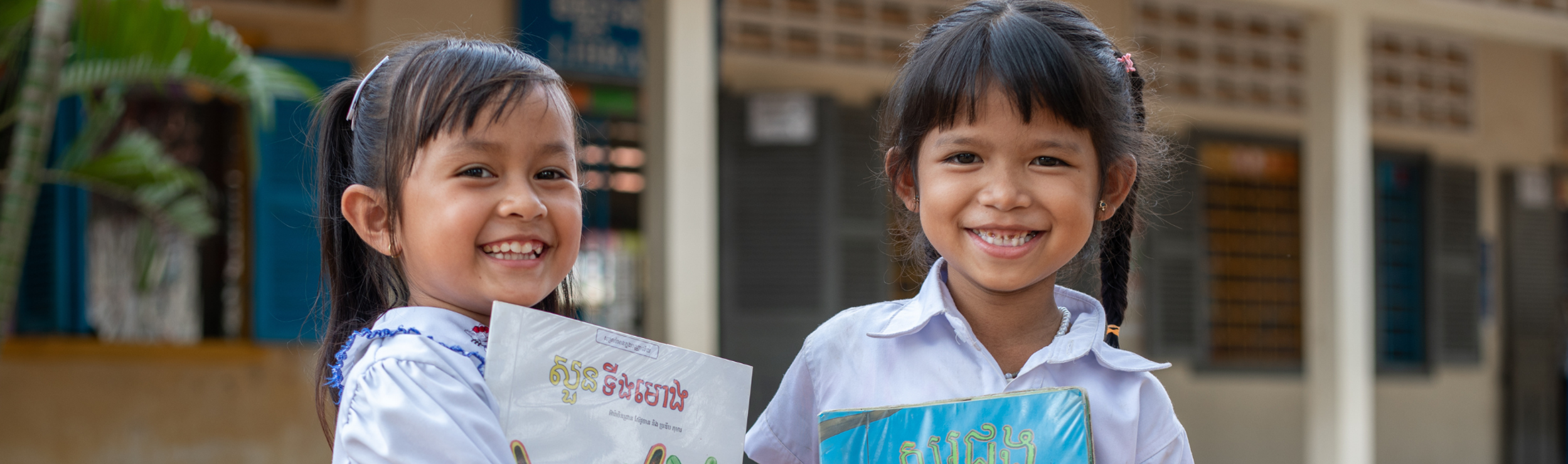
Current learning challenges
The Cambodian government has been strongly focused on efforts to improve the quality of the education system, boosting enrollment rates in recent years, but classrooms throughout the country still remain severely under-resourced in Khmer language books, and educators are ill-equipped to effectively teach young students how to read and write. The situation is even more critical for children in rural and marginalized communities, where more than half will not reach secondary school, severely limiting their future potential.
For girls especially, the often-stringent cultural norms and economic uncertainties in Cambodia discourage girls and women from participating as leaders in their communities, or from pursuing lucrative employment opportunities. Due in large part to societal pressures, too many girls drop out of school early to marry or support their families, further hindering their future earning potential. Even for the girls who stay in school, too few are taught the life skills they need to advocate for themselves, and the lack of gender-inclusive training for teachers further exacerbates girls’ learning outcomes.
Girls, without the confidence or knowledge to address gender inequities affecting their lives, will remain caught in spirals that keep girls vulnerable to economic and social exploitation, including early marriage and pregnancy. Without intervention, too many girls will continue to earn less income, experience poor health and wellbeing, and never gain agency over decisions that affect their lives and futures. As of 2022, Cambodia ranks 122 out of 170 countries on the Gender Inequality Index, representing one of the most challenging regions for women and girls to determine their own futures.
The Latest from Cambodia

Closing the gap: How a well-trained teacher helped an older student catch up

Life skills education and a life transformed
Dany So, Communications Officer, Room to Read in Cambodia


Empowering youth, transforming mindsets: Lessons from our Life Skills for Equality Project
Abigail Spangler, Associate Director of Room to Read's Girls’ Education Portfolio

Room to Read Cambodia Recognized as Laureate of 2022 UNESCO Prize for Girls’ and Women’s Education

Measurement insights from our Life Skills for Equality Project
Fernanda Gándara, Director of Research, Monitoring and Reporting, Girls’ Education Portfolio

Facing challenges with life skills
Meet Theannou from Room to Read in Cambodia


Developing a lifelong love of reading
Meet Sreykeo from Room to Read in Cambodia