
Updates from Lebanon and Palestine
April 29, 2026
By Dina Elabd
Project Manager
Room to Read in the Middle East
“In one of the shelters in Ablah Public school, a child sat quietly on the ground with a small box of coloring pencils placed in his hands. For a moment, the noise of the world around him faded. What he held was not just pencils; it was a chance to imagine.
With simple lines on a piece of paper, he began to draw. Maybe his house, from which he is displaced, maybe a road to a safer place, maybe a future that feels better than the current war.
In places where children are often surrounded by uncertainty, a small activity like drawing becomes something powerful, a way to express hope without needing many words. His smile in this photo tells a story stronger than the circumstances around him.
Even in a shelter, even during difficult times, a child’s dreams remain colorful, bright and full of life. Sometimes, all it takes is a few pencils and a little space to remind a child that their future is still theirs to draw. Thank you, Room to Read.” – Lebanese Organization for Studies and Training (LOST), a Room to Read partner organization in Lebanon
As Lebanon and Israel exchanged fire in recent months, entire communities evacuated from southern Lebanon, as well as Baalbeck and Beirut. More than a million people are internally displaced in Lebanon, including families with children. Many of those families have moved into public school shelters as public schools have all closed.
In close partnership with the Lebanese Organization for Studies and Training (LOST), Room to Read has continued our emergency operation in Lebanon in support of displaced families. Recognizing that learning cannot happen without physical well-being, Room to Read and LOST have so far distributed 11,400 meals to 3,609 individuals and 937 food parcels, which will feed a small family for roughly a month, to 2,633 individuals.
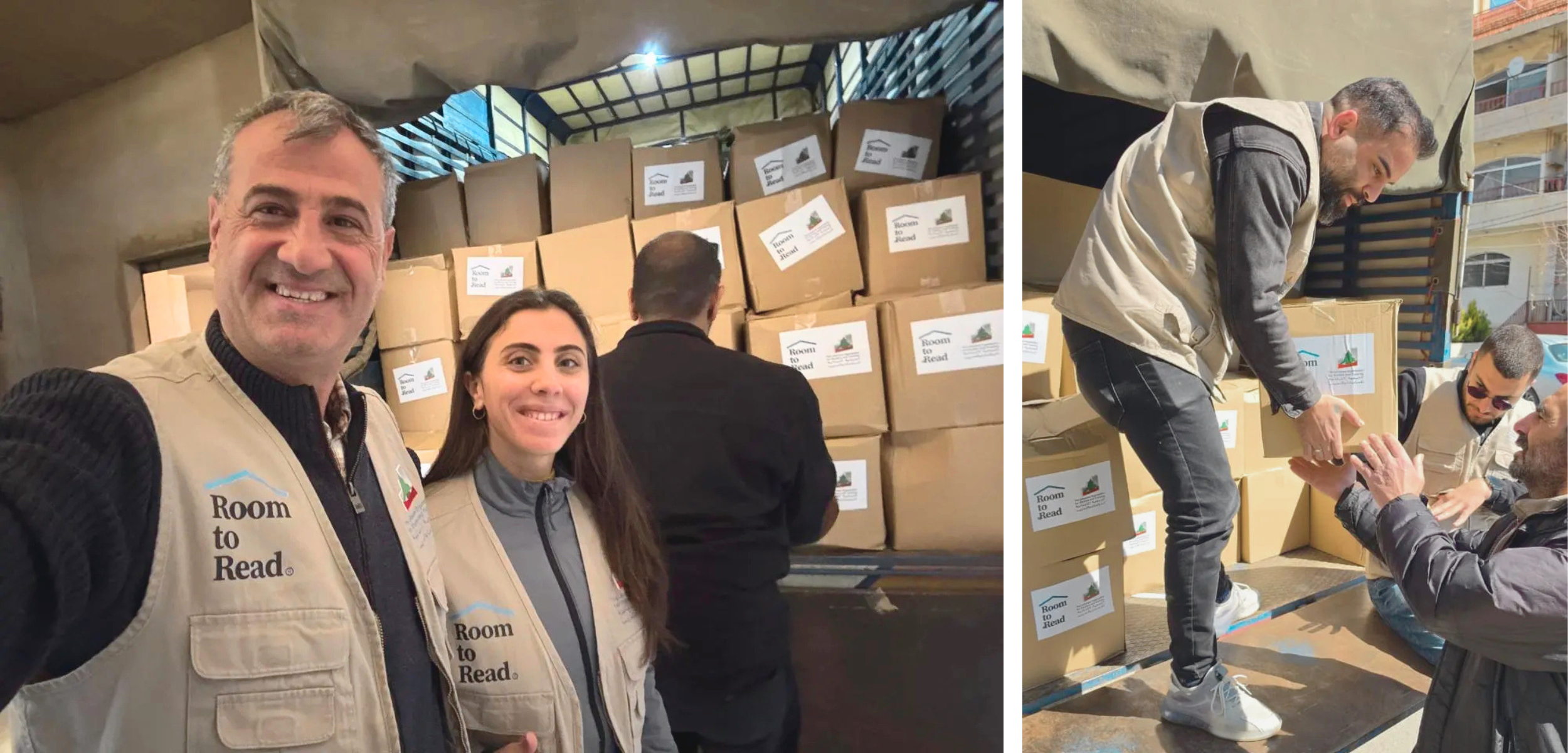
After receiving approval from the Lebanese Ministry of Education, we also began our emergency education intervention, establishing reading sessions in shelters and community gathering spaces with books that nurture social-emotional learning, literacy development and life skills. These books have so far been distributed across 10 emergency shelters. Twenty-three emergency shelters are now helping children build literacy skills and nurture reading habits through Room to Read's literacy and library programming, and six emergency shelters are partnering with Room to Read to implement our life skills programming for adolescents.
Twice a week, children gather for interactive 45-minute sessions that blend active listening and immersive storytelling to spark imagination and creative expression, including drawing and group discussions to help children process emotions.
These sessions — held in schools, churches and community centers — offer engaging, hands-on activities that support children in strengthening phonemic awareness, vocabulary and reading comprehension. And they offer more than literacy support; they restore a sense of routine, safety and joy.
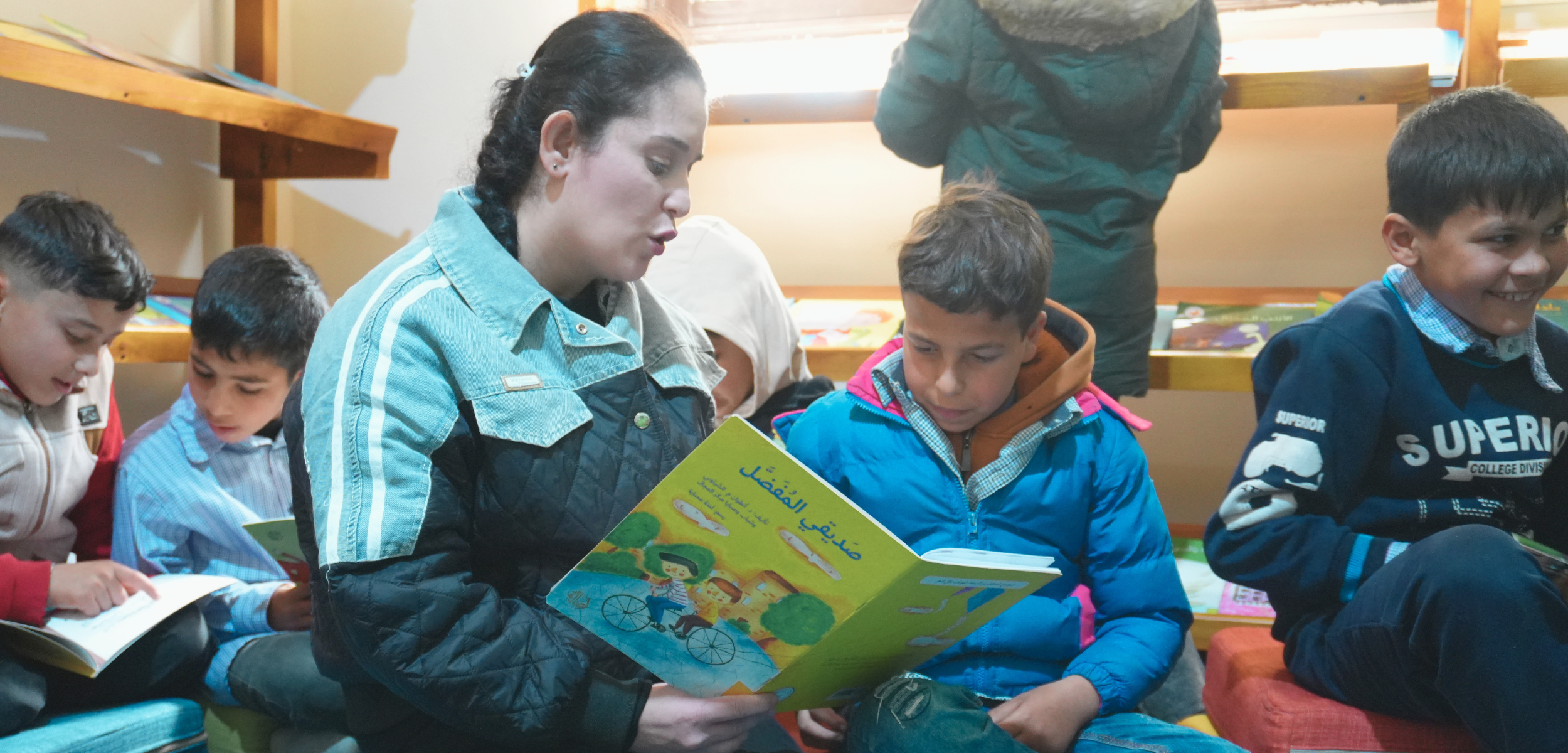
“I was scared when we left home, but I’ve made friends here,” shared Kayan, who is sheltering in a public school-turned-emergency shelter. “When we read, I can picture us all safe and smiling again.”
Our approach successfully combines literacy activities, including read-aloud sessions and reading activities, with immediate support of basic needs, and we remain responsive to changes in the operating environment. Addressing both learning and basic needs, like hunger and nutrition, enabled us to respond holistically to the wide variety of challenges faced by local children and families. Similarly, flexible planning ensured we were poised to transition quickly to shelter-based activities as conditions changed, ensuring continuity of learning with minimal interruption.
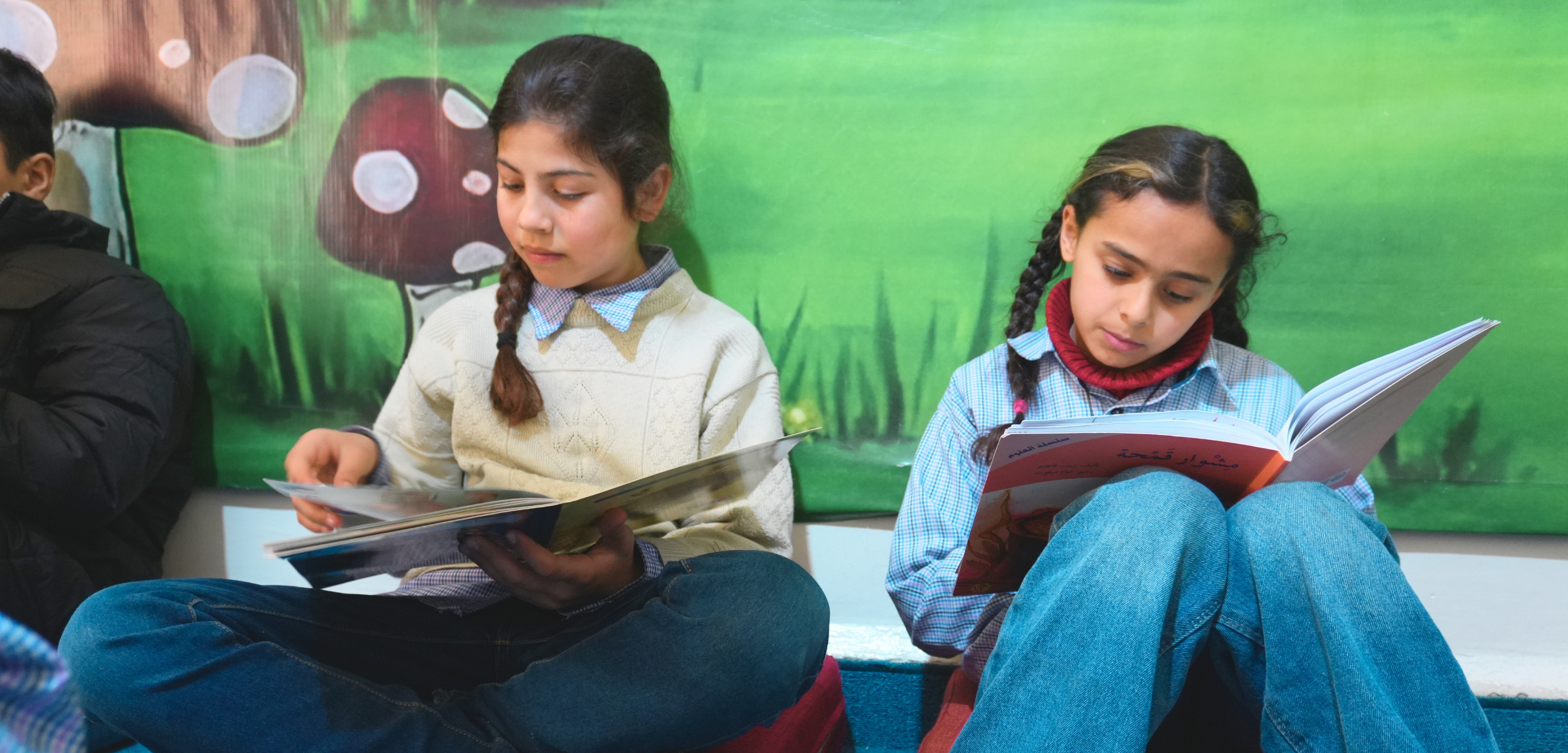
“I miss my toys, but reading stories together makes me feel safe,” shared Ranim, who is staying in an emergency shelter. “It’s like traveling somewhere far away where everything is quiet.”
Updates from the region...
Our Palestine Book Collection
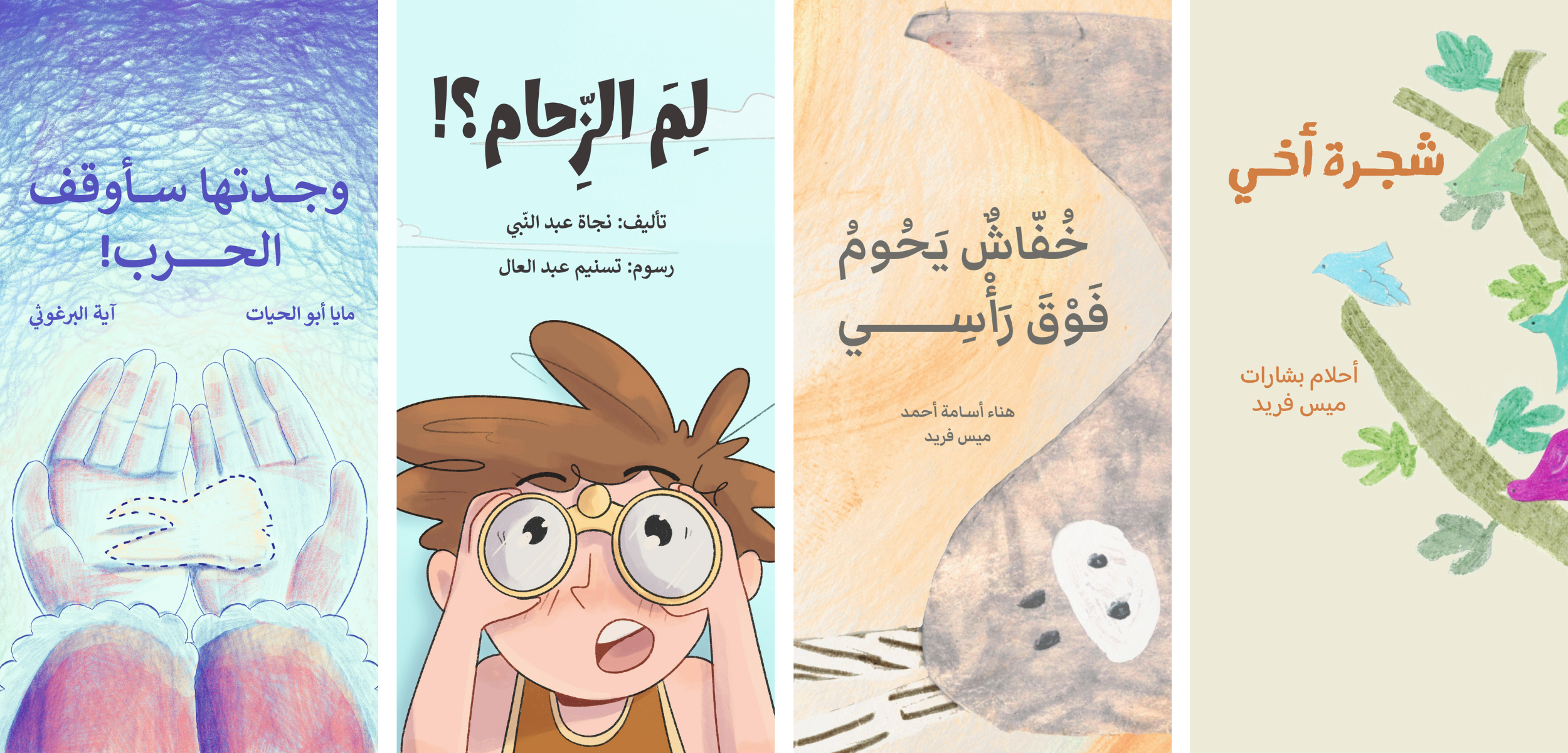
This January, we successfully printed and distributed eight of the 10 titles in Room to Read's original Palestine Book Collection to every elementary public school in the West Bank — 88,000 titles to 1,570 schools in total. Since then, an additional title has been approved by our government partners, and all 10 titles are now available on Literacy Cloud in Arabic.
Discover Arabic books on Literacy Cloud
With our local publishing partners in Palestine, Tamer Institute and Atafeal, and the Ministry of Education, we are also developing teacher reading guides to accompany these 10 titles. These teacher guides will ensure educators are well prepared to guide children through the stories, with reading activities and strategies for reading comprehension. The Ministry of Education in Palestine envisions these titles becoming the basis of small but powerful classroom libraries, and recently signed a new agreement with Room to Read and the Tamer Institute to implement teacher trainings beginning June 2026 at three locations across the West Bank, supporting 75 teachers and librarians. As part of the training, educators will receive Room to Read training booklets, allowing them to take our educator training and coaching content back to their schools to share with fellow elementary teachers.
Curriculum and content in Modern Standard Arabic
Room to Read's first-ever Grade 1 early reading curriculum in Arabic is nearing completion! Developed by Room to Read in partnership with literacy experts from Egypt, Lebanon and Jordan, the curriculum was workshopped in Cairo in early 2025 and finalized later that year. With approval from the Ministry of Education in Lebanon, we were able to pilot the curriculum in emergency education settings early in 2026 and plan to disseminate the curriculum to an additional 12 sites — non-formal and semi-formal schools — as well as summer education programs. A teacher’s guide was also developed with plans to share the final version with local governments throughout the region in June 2026.
Now, our attention is acutely focused on Grade 2 curriculum. Having both Grade 1 and 2 curricula in Modern Standard Arabic will ensure we can offer a robust literacy intervention package to local governments, which will help ensure swift adoption. A Room to Read curriculum content workshop is organized for June 2026 in Cairo and student and teacher guides are set to be published by February 2027.
Get our emails for more updates

You might also be interested in...

The latest from Room to Read in Lebanon
Dina Elabd, Room to Read project manager in the Middle East

