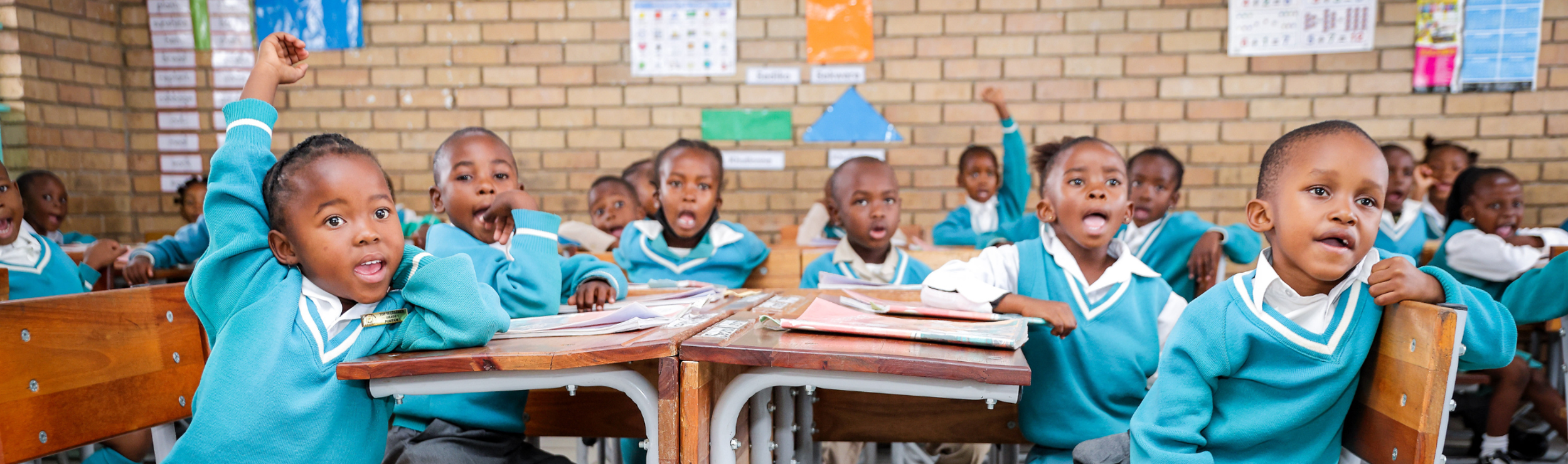
Where We Work - South Africa

Introduction

South Africa Map

Situated on the southern tip of the continent, South Africa is one of Africa's super-powers and is the starting point for Room to Read in Africa. An emerging market with an abundant supply of natural resources; well-developed financial, legal, communications, energy, and transport sectors; and a stock exchange that ranks among the ten largest in the world, South Africa boasts a modern infrastructure supporting an efficient distribution of goods to major urban centers throughout the region. Yet, daunting economic problems remain from the apartheid era - especially widespread poverty and the lack of economic empowerment among disadvantaged groups. In fact, South Africa has one of the largest income disparities in the world, with over 45% of the total population living below the poverty line. (1)

From 1948 until 1994, a white minority ruled South Africa using the policies of apartheid to separate races and resettle hundreds of thousands of citizens. Today the South African government is proceeding gradually to a market-oriented economy supported by state subsidies, undergoing privatization and slow job creation.

Under the leadership of Nelson Mandela, who during his 27 years in prison provided a moral compass for rebelling against apartheid, the African government came into power in 1995. The new government embraced reconciliation with the past to heal the wounds of the nation. Although the process of healing has continued, social change has been slow due to apartheid's legacy of persistent crime and chronic lack of educational opportunities. In addition, the HIV/AIDS epidemic has reached catastrophic proportions affecting all aspects of life in South Africa including education.

Indeed, South Africa is experiencing one of the most severe HIV epidemics in the world. By the end of 2005, there were 5.5 million people living with HIV in South Africa, and almost 1,000 AIDS deaths occurring every day, according to UNAIDS estimates. (2) A survey published in 2004 found that South Africans spent more time at funerals than they did having their hair cut, shopping or having barbecues. It also found that more than twice as many people had been to a funeral in the past month than had been to a wedding. Education is of tantamount importance to fighting the HIV/AIDS epidemic - education will help break the walls of ignorance that have led to the spread of the disease. (3)

Educational Challenges

South Africa

From 1948 to 1994 South Africa's educational system provided a vehicle to ensure the control of apartheid. Discrepancies existed at every level of the system - in teacher/student ratios, in infrastructure, in availability of books and materials, and in required attendance. This was further worsened by the "liberation now, education later" stance taken during the years of the anti-apartheid struggle, which severely damaged the culture of learning and teaching in schools and universities. Instead of places of learning, schools became sites of protest.

On June 16th, 1976, riots broke out among the children and youth of the township Soweto, providing the catalyst for the eventual demise of the white minority government. The riots were sparked by a decision by the Education Department to require one half of all high school classes to be taught in Afrikaans. Over fifty South Africans died in the ensuing violence, many of them children. Through the following 18 years of struggle to the downfall of the government in 1994, education was a key issue. In 1993, the South African government began to see the failure of the system, and gathered experts to formulate a policy framework for restructuring education. In fiscal 1993-94, 23% of the budget was spent on educational transformation and integration. (4) This effort, however, only began to address the systemic racism that existed under apartheid.

In 1995, the newly-elected ANC government under President Mandela initiated a number of policies to improve overall access to education as well as the quality of programs and equality for all races. A few years later, Professor Kader Asmal, the Minister of Education, authorized a "Call to Action" to ameliorate the poor quality of the teaching force by re-distributing teachers to schools that historically had not received trained educators, by providing teacher training, and by developing an outcome-based curriculum. Although these main objectives were achieved by 2004, the program inadvertently increased the number of uneducated teachers in classrooms by lowering teacher/student ratios and enabling privileged schools to cushion their student-teacher numbers through the hiring of additional teachers. Despite some improvement in the general quality of primary education, poor quality persists especially in the lower socio-economic, all black, and provincial homeland schools.

Orlando High School in Soweto is the state-run school that many of the students who participated in the 1976 Soweto riots attended. In 2006, 30 years after the uprising, the educational situation continues to be devastating. For the current 900 students, one teacher on staff is qualified to teach the three sciences offered, a computer lab sits empty with no computers, and a library has books, but none that are up-to-date and relevant. Of all the state-run South African schools, 80% have no library! (5)

Even after ten years of concerted effort, schools' pass rate for the national exams was less that 50% for three of the last five years. Of whites over 20, 65% have completed high school. In the same age group of blacks, only 14% have a high school diploma. (5)

The Department of Education acknowledges that 'there is considerable evidence that the quality of education in South African schools is worryingly low relative to what South Africa spends on schooling.' Much of the concern stems from the discrepancy of educational quality in urban and rural areas. Specific problems endemic to rural areas include overcrowding, poor school infrastructure (including collapsing ceilings and broken windows), high student to teacher ratio, students having to walk great distances to get to school, and lack of educational materials.

In addition to the rural discrepancy there are other important educational issues facing South Africa, including:

  • educational opportunities for girls - although there is parity in enrollment rates between both genders, there is a growing need to keep girls in school
  • improving early stage reading and writing skills
  • managing the storage and distribution of books (both text books and supplementary books) - many government schools are not receiving shipments of textbooks, a situation that is only exacerbated by the lack of school libraries
  • early childhood development - overlooked by the government in recent years
  • HIV-AIDS awareness programs in schools

Room to Read's Role

In April 2006, Room to Read selected South Africa as our first African country. This decision was the culmination of nearly a year of research and strategizing about potential expansion onto our second continent. The process included the study of macro political, economic, and educational indicators; the hiring of an outside consultant to research all opportunities for the organization; discussions and networking with various non-governmental organizations working throughout the continent; and concluded with a month-long, on-site investigation of the two finalists for our initial African country (South Africa and Ethiopia). With vast amounts of quantitative and qualitative data, and testimonials from organizations and government officials on the ground, management unanimously selected South Africa. To read more, please view the Africa Expansion Article in our 2006 Q2 Newsletter.

In addition to obtaining our license to operate in the fall of 2006, we began hiring a talented team of local employees that are responsible for rolling out our various programs across South Africa. In 2006, we launched our Reading Room Program in the Eastern Cape and Mpumalanga and have started publishing children's books in Xhosa, Zulu, and SiSwati as part of our Local Language Publishing Program.

Programs & Results

Room to Read South Africa establishes libraries and publishes new children's books so that South African children have increased opportunities for education. We will continue to expand these programs and our geographic reach in order to give the lifelong gift of education to as many South African children as possible.

Program Total Thru 2008 2009 (Projected)
Libraries Established 120 70
New Local Language Titles 12 10
Schools Constructed - -
Girls' Education Participants - -

How You Can Help

"For to be free is not merely to cast off ones' chains but to live in a way that respects and enhances the freedom of others."

- Nelson Mandela

Forever altering the lives of the children of the world by providing them with an education is an essential and attainable goal. Every human being deserves the right to the knowledge and self-determination provided by the ability to read and write. World change starts with educated children. You can make the difference by getting involved in one of the following ways:

Donate Donate to Room to Read South Africa.
Adopt a Project Help establish one or more libraries or sponsor a local language children's book title in South Africa.
Volunteer Learn about volunteer opportunities with Room to Read.
Email Updates Sign up for our email newsletter to get regular updates on the organization, our programs, and more.

Room to Read South Africa - In Detail

Established 2006
Country Director Mr. Christopher Mothupi
Number of Employees
(as of 10/31/2008)
7
Office Location(s) Pretoria
Regional Presence Eastern Cape, Mpumalanga
Key Partners Bioblionef

(1) Human Development Report - South Africa

(2) UNAIDS 2006 Report on the Global AIDS Epidemic

(3) South Africa Advertising Research Foundation All Media Survey

(4) www.countrydata.com

(5) UN Office for the Coordination of Humanitarian Affairs