
Access to a quality education in India has been a longstanding challenge across the country as a result of compounding historical, cultural and political factors. Following nearly two centuries of British rule that reinforced a discriminatory caste system and made education only available to the elite, India is still working to overcome deep-rooted social and cultural beliefs that perpetuate gender discrimination and limit educational opportunities for lower-income and marginalized groups. Pernicious cultural norms and resulting social and economic barriers continue to cause children from low-income communities, children with disabilities and children from minority communities to be the least likely to learn basic skills. As a result, children who live in the most vulnerable regions throughout India experience the greatest risk of dropping out of school, threatening their quality of life, health, and future economic opportunities. Given India’s growing youth population — as India recently surpassed China as the world’ most populous country, with an estimated more than 1.4 billion people — implementing immediate and lasting enhancements to the education system is essential to ensure millions of young people are not left behind. Despite the transformative power of literacy, 56 percent of 10-year-olds in India are unable to read simple text, according to the World Bank, resulting in persistently high illiteracy rates. Though primary school enrollment rates have increased over the last few decades, many schools across the country continue to struggle to ensure children are effectively learning foundational literacy skills and have access to high-quality books and libraries. Historical context
Since its independence in 1947, India has been working to address its many development challenges, with educational reforms being one of its core areas of focus to create a brighter, more prosperous future. The Kothari Commission Report (1964–1966) outlined a comprehensive roadmap to expand educational opportunities and improve quality resources for students across the country. However, fully implementing these reforms proved challenging due to limited resources, population growth, and regional disparities.
While the government's subsequent education policies have often been influenced by political considerations and economic priorities, there have been periods of substantial progress. Notably, the Sarva Shiksha Abhiyan (SSA) was launched in 2001 to achieve universal elementary education, and prioritized teacher training and resource development, and also introduced a mid-day meal in schools to attract and maintain student attendance. SSA has played an instrumental role in demonstrating that investments in education work – this initiative helped make significant progress toward achieving universal elementary education in India. However, there remain obstacles in achieving equitable education access and outcomes across the country, especially for those living in remote and marginalized areas where deep-rooted social biases continue to pose significant challenges.
The government continues to prioritize overcoming longstanding barriers to quality education for all, and launched the National Education Policy (NEP) in 2020 as a framework outlining a path toward achieving a comprehensive, student-centered and research-informed education system. Among the initiatives created to operationalize the NEP’s broader goals, the government launched the National Initiative for Proficiency in Reading with Understanding and Numeracy (NIPUN Bharat) to ensure critical educational reforms are completed at the national, state, district, block, and school levels to improve foundational literacy and numeracy by 2027. NIPUN Bharat's mission is nothing short of urgent — it aims to ensure that every child in the country gains foundational literacy and numeracy skills by the end of Grade 3. 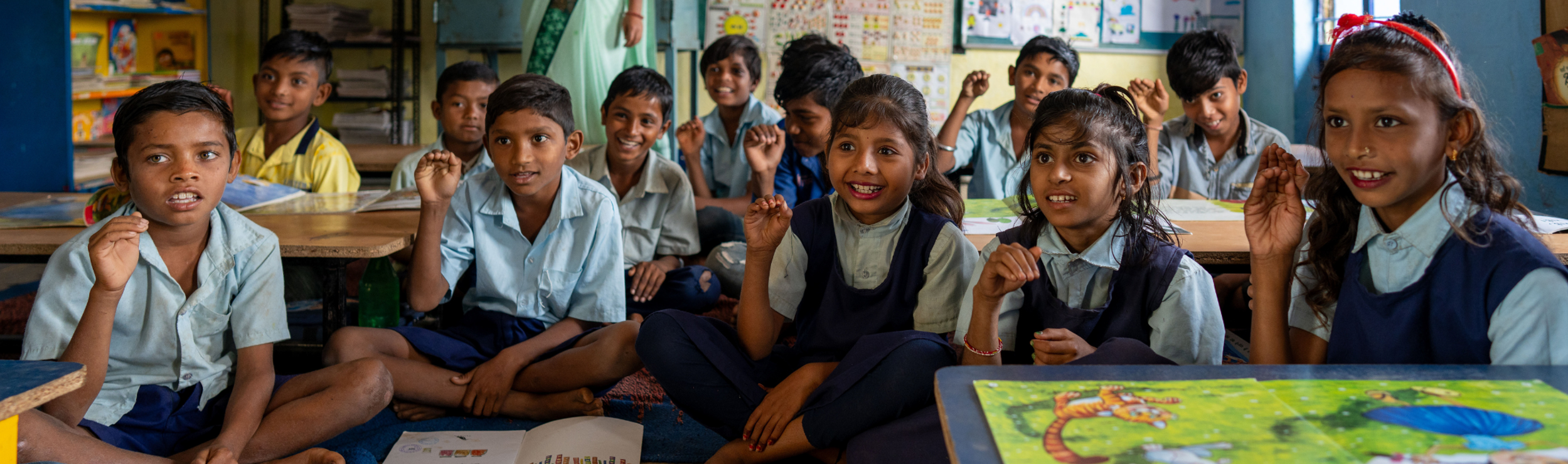
Current learning challenges
For girls and women in India, the outlook is especially grim, as early marriage, child labor and household responsibilities too often pull them away from their time in school. According to UNICEF, one in three of the world’s child brides lives in India, with at least 1.5 million underage girls married in India annually. Further, more than half of girls and women who married before age 18 live in five states: Uttar Pradesh, Bihar, West Bengal, Maharashtra and Madhya Pradesh. Devastatingly, less than 20 percent of married girls stay in school, and, compounded with other factors pulling girls away from an education — including the stigmas and needs related to menstruation, which is the second leading cause after child marriage that leads girls to drop out of school — nearly 40 percent of adolescent girls in India, aged 15–18, are currently deprived of education.

India
The Latest from India

Addressing linguistic complexity in Indian classrooms
Stuti Jain, Manager of Instructional Design and Structural Support

When girls go to school, who takes care of everyone else?
Nivrita Durgvanshi, Associate Director, Literacy Portfolio

Literacy interventions at scale: Building systems that deliver
Saktibrata Sen, Senior Director of Programming for Room to Read in India

Measuring life skills among boys in India and Nepal
Dhiraj Anand, Associate Director, Research, Monitoring and Evaluation, Gender Equality Portfolio

From self-defense to self-confidence: Meet Yashika from She Creates Change


